
Silage: Preparing for Winter in 30 Degrees

August 2026

It's been a scorching summer, and for farmers this dry weather brings both joy (no mud!) and challenges (dust! dehydration!). Speaking of farmers, they were nowhere to be seen around Tablehurst Farm for a few days at a time. Did they all disappear off to the beach? Not exactly, but one farmer claimed the temperature was similar to that of Barbados. They were in fact working day and night, up at Great Cansiron Farm, preparing silage to feed our cattle this winter.
Firstly, what is silage?
In simplistic terms, farmers produce three categories of winter cattle feed: hay, haylage and silage, which are differentiated by the levels of moisture in them. Hay has to be completely dry, so is laid out and turned several times in the sun, before it is baled. Haylage is hay that has retained the last bit of moisture and wrapped in plastic so there is a degree of fermentation. Silage is made from crops that are cut, baled and wrapped while moist, which allows it to ferment into nutrient-dense livestock feed for the winter months. It’s essential that air is expelled from the silage crops before they are wrapped and they are then not exposed to any air, light or additional moisture (so no holes in the wrapping please), otherwise mould will start to grow and the silage cannot be eaten.
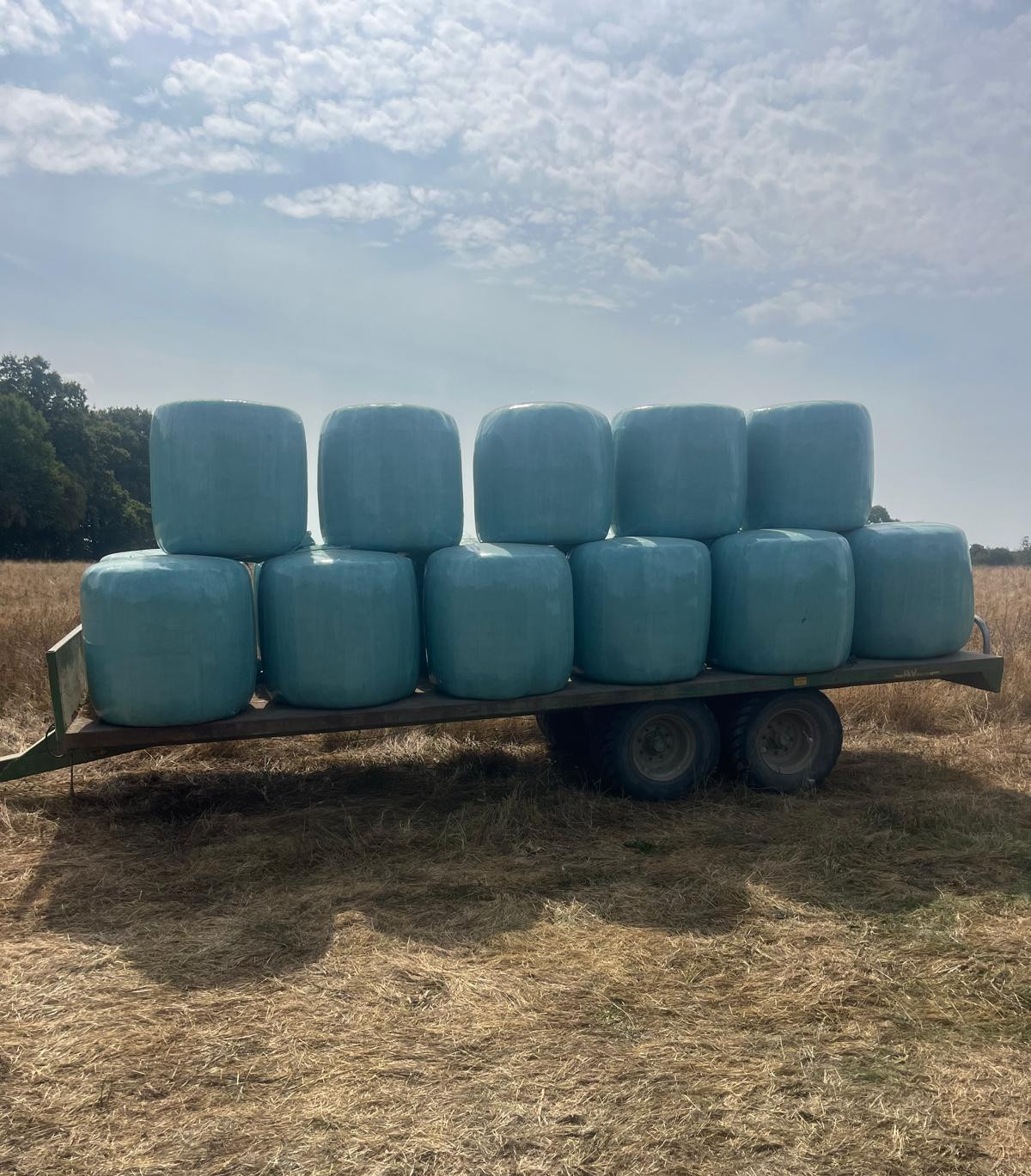
At Tablehurst Farm we produce all three types of feed. With all three, the preparation involves a five-stage process. Firstly, the fields are mowed. Then a machine called a tedder, which has four spinning rakes, is used to turn the cut crops, so they are spread out evenly and exposed to the sun. The dryer we want the feed, the more times we will apply the tedder to the silage and leave it out for longer. When the Farm Manager is happy with the condition of the fodder, we then use our new double rake which pulls the grass from a wide area and forms it into long low rows called windrows. We then bring in the baler to pick it all up and roll into round bales. If the final product is intended for hay, it has to be bone dry as damp hay can cause barn fires through spontaneous combustion. If the product is intended as haylage or silage, it is wrapped in plastic and then stored for the winter.
OK but where did the farmers actually go?
This year we focused on gathering silage on Great Cansiron Farm, which is over 400 acres of land leased to us by the Great Cansiron Holistic Trust since last year. Last spring we sowed, on this land, seeds for herbal leys (see our Sept 2025 blog article about this journey), which grew into a very diverse community of plants such as chicory, yarrow, various clovers and legumes, together with a variety of grasses.

The acres of rich herbal leys at Great Cansiron Farm are used for cattle grazing during the spring and summer. Anything not grazed is cut and baled into winter feed. In other words, this new land is providing our cattle with much more food over all four seasons. With this we can in turn increase our herd size so we now have more Jersey (dairy) cows than before, but there is still room for expansion. The nutritional content of the herbal leys, both freshly grazed and in silage, means that we can produce rich, top-quality milk for the calves, who grow up healthy, and to sell the milk to our customers. We hope to expand our Sussex (meat) herd in the future too.
Why do silage in the middle of summer?
Historically, once the spring arrives we look for the first appropriate window to do substantial silage. This depends on whether the crops have grown enough so there’s enough to cut. If cut too early, the ground is still wet and soil can be damaged by compaction (becoming denser because water is squeezed out by pressure). Cut too late and the crops are too mature, and have lost nutritional content. Plus we need a window of fine weather so the ground is relatively dry for the machinery. Quite a headache for our Farm Manager! Last year we had to cut later because we had a drought in spring and early summer, so it was mid to late summer before the seeds we sowed grew into thick herbal leys. This year we cut much earlier because we had a wet spring followed by scorching heat and sunshine, so there was a lot of growth and the crops were ready much sooner.
In total, we made around 2000 bales this summer, which was hard work as it was very hot, and on some days our farmers worked until past midnight to make the most of these windows. But we will have happy, well-fed cattle this winter for which we feel extremely blessed!


Totally agree with the author, this topic is super relevant right now. Some time ago I came across https://silukr.org and now I often use it as a reference for finding useful information. For related questions, I also occasionally check https://whatiscfdtrading.org/ which is another solid source. Has anyone else used them? What do you think of their content? Personally, it saves me a ton of time.